{{text}}
Share
What is local SEO and why is it essential in 2026?
The Local SEO is a SEO discipline that targets location-based queries to make a business appear in proximity results from Google, Maps and AI response engines.
When a user types in “Italian restaurant Paris 11" or “Lyon web agency”, Google displays a specific block called the Local Pack : 3 establishment sheets with map, reviews and contact details. Appearing in this top 3 generates on average 5x more clicks than a classic organic result for local queries.
The numbers speak for themselves. 46% of Google searches express a local intention (Google, 2025). 76% of mobile users visit a business within 24 hours after a local search. And 28% of these visits result in a purchase (Google/Ipsos). For B2B companies with a geographical base (consulting firm, agency, service provider), local SEO represents an acquisition channel with an x3 ROI compared to paid channels over 12 months.
In 2026, the local referencing exceeds Google Search. AI response engines (ChatGPT, Perplexity, Gemini) now respond to local queries based on Google Business Profile data, reviews, and NAP quotes. A well-executed local SEO strategy therefore feeds your visibility across all discovery channels.
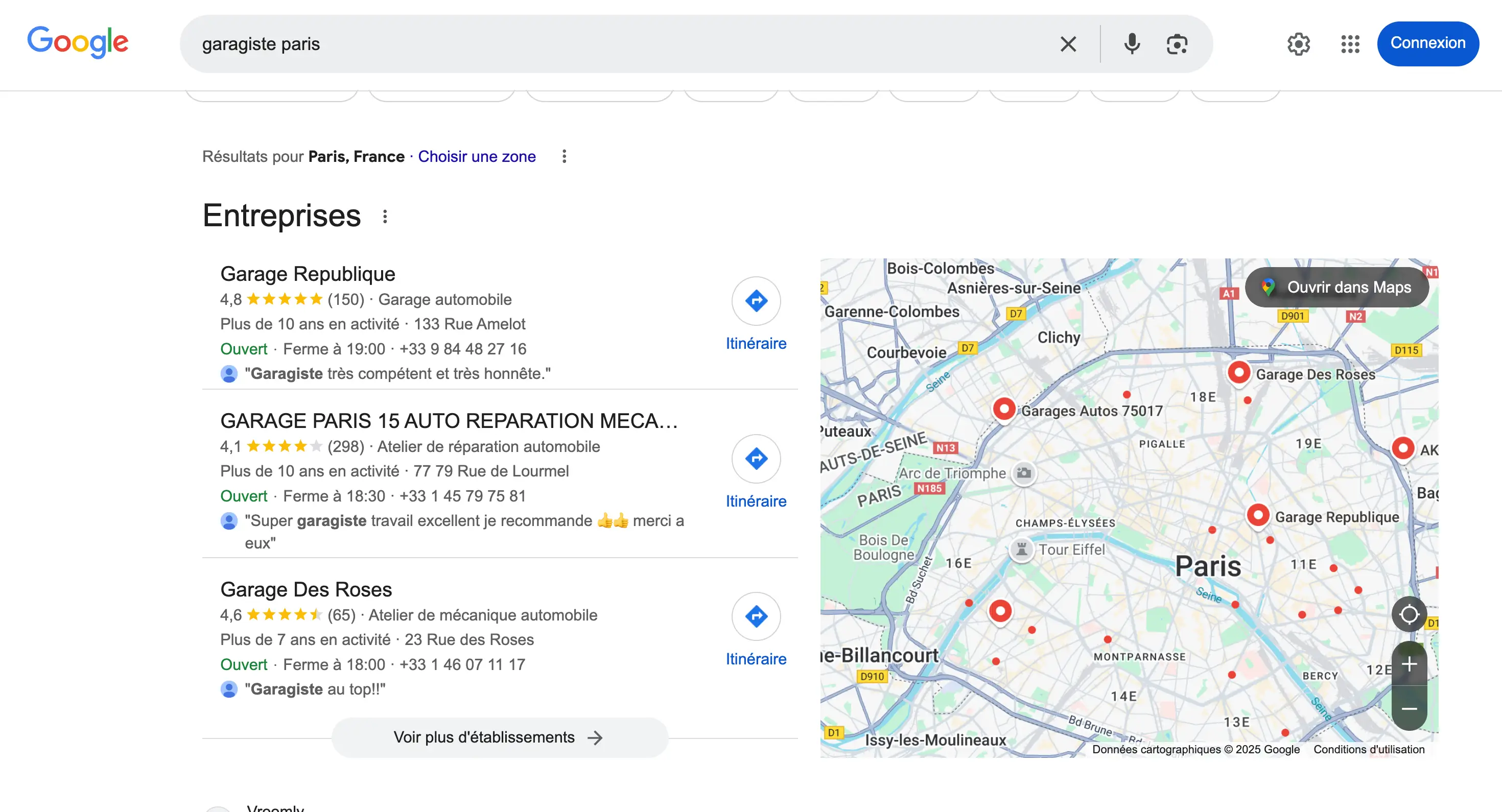
The 5 ranking factors for local SEO according to Google
Les local SEO ranking factors are the criteria used by the Google algorithm to determine which businesses appear in the Local Pack and Google Maps for a given query.
According to the Whitespark 2026 report, here is the weighting of the 5 main factors:
- Geographic proximity (~ 55% of the weight): the distance between the user and the company. It's the biggest factor and the only one you don't have direct control over.
- Google Business Profile sheet (~ 25%): the completeness, the quality of the information, the categories chosen, the photos and the frequency of publication.
- Customer reviews (~ 17%): the volume, average grade, recency and quality of the company's responses.
- On-page signals (~ 10%): optimizing the website for local requests (title tags, content, LocalBusiness structured data).
- NAP quotes (~ 8%): the consistency of the Name, Address and Telephone on directories and third party sites.
“Proximity accounts for 55% of the score, but the remaining 45% is entirely in your hands. On our +150 projects, we found that optimizing the GBP form and managing reviews are the two levers with the best effort/result ratio. “, James Brunetto, CMO and Co-Founder, Synqro.
How do you optimize your Google Business Profile?
Google Business Profile (formerly Google My Business) is Google's free tool that allows businesses to manage their online presence on Google Search and Google Maps.
A complete GBP sheet receives 70% more visits and appears 18 times more often in search results than an incomplete listing (Google, 2025). Here are the elements to optimize as a priority.
Our 8-step method for an optimized GBP sheet:
- Main category : choose the most specific category possible. “SEO Agency” is better than “Digital Marketing Agency.” Add 2-3 relevant secondary categories.
- Description : write 750 characters with the main keyword in the first 100 characters. Include geographic area, key services, and a differentiator.
- Photos and videos : add 10+ quality photos (facade, interior, team, products). Cards with 100+ images get +570% of calls on average.
- Schedules : complete all slots, including holidays and special hours.
- Services and products : list each service with a description of 150-300 characters including local keywords.
- Google posts : publish 2+ posts per week (offers, events, articles). In 2026, the frequency of publication became a leading ranking signal.
- Questions/Answers : pre-fill current FAQs directly into the form.
- Attributes : complete all available attributes (accessibility, payment, specific services).
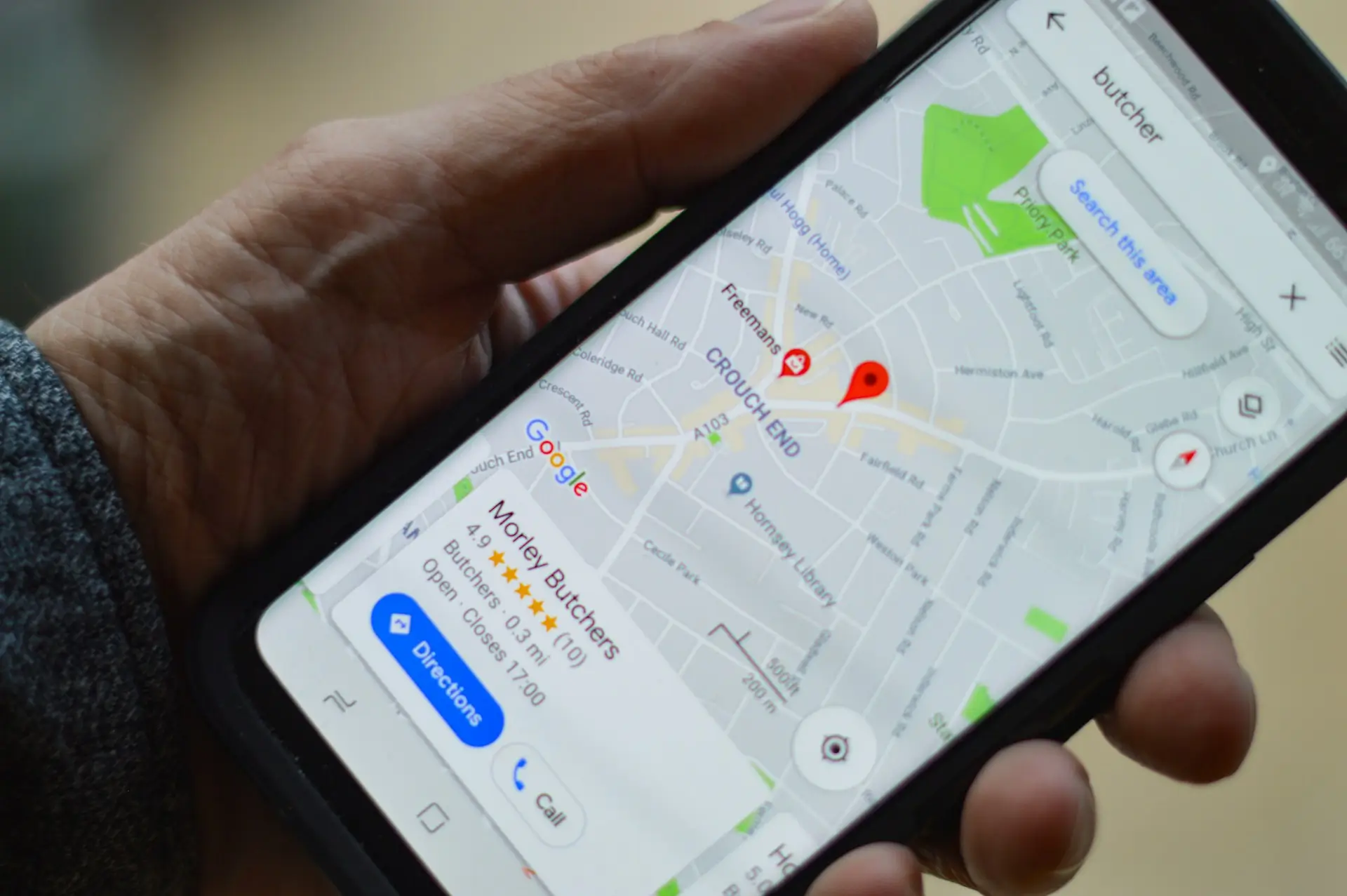
In practice at Synqro: For Les Fermes de Marie (luxury hotel in Megève, real estate/luxury sector), we carried out an exhaustive SEO audit that revealed 50 technical problems impacting local visibility. After correcting and optimizing the local organic strategy, the establishment has sustainably strengthened its visibility on geolocated queries related to luxury hotels in Haute-Savoie. Result: +50 technical corrections and a sustainable organic strategy.
What customer review strategy should you adopt for local SEO?
La customer review strategy in local SEO is a systematic process of collecting, managing, and responding to Google reviews to improve Local Pack rankings and conversion rates.
The reviews represent 16 to 20% of the weight ranking in the Local Pack (Whitespark, 2026). Going from 3 to 5 stars increases the click through rate by 2 600%. Recency counts as much as volume: 30 reviews obtained regularly over 6 months send a stronger signal than 200 reviews accumulated over 5 years.
The 5 rules of an effective review strategy:
- Systematizing the request : send a Google Review link to each customer 24-48 hours after the service. Average response rate: 10-15% with a simple email, 25-30% with an SMS.
- Respond to 100% of reviews : positive and negative, within 24-48 hours. Include the customer name and a local keyword in the response. Google analyzes the content of the answers.
- Aim for a steady pace : 4-8 new reviews per month for a local SME. Regularity takes precedence over occasional peaks.
- Diversifying platforms : Google first and foremost, but also Yellow Pages, Trustpilot and sector directories. Cross-platform consistency builds trust.
- Never buy reviews : Google detects artificial patterns (same IP, same wording, sudden spikes) and penalizes the form.
Across our +150 B2B projects, we found that active review management is the most underexploited lever. 73% of the B2B companies we audit have never responded to a single Google review.
NAP quotes: how do you manage them effectively?
Les NAP quotes (Name, Address, Phone) are mentions of the name, address and telephone number of a business on online directories, social networks and third-party sites, used by Google to verify the legitimacy and location of an establishment.
NAP coherence represents approximately 8% of the weight of local ranking (Whitespark, 2026). An inconsistency (different address between the site and the directories) can cause your position in the Local Pack to drop.
The 10 priority directories for local SEO in France:
- Google Business Profile
- Yellow Pages/Solocal
- Yelp France
- Facebook (business page)
- LinkedIn (company page)
- Apple Plans (Apple Business Connect)
- Bing Places
- TripAdvisor (if tourism/catering sector)
- Sectoral directories (Houzz, Doctolib, Malta depending on the business)
- Chambers of Commerce and Industry (CCI)
The golden rule: the NAP must be exactly the same everywhere. Even “12 rue de la Paix” vs “12, rue de la Paix” is an inconsistency that Google can detect. Audit your quotes every 6 months with a tool like BrightLocal or Moz Local.
Fundamental distinction between classic SEO and local SEO
Traditional SEO is characterized by a national or international reach, with the main objective of generating qualified web traffic. Key factors are based on content, backlinks, and technical aspects. The results appear in the form of classic organic links, responding to informational or transactional user intent.
Local SEO, for its part, targets a specific geographic area (city, neighborhood, region). Its main objective is to generate store visits and phone calls. Key factors include the Google Business listing, customer reviews, and local quotes. The results are displayed in the Local Pack and on Google Maps, responding to a navigational intent oriented to immediate action.
The Local SEO responds to a major evolution in search behavior. Search engines, led by Google, have developed sophisticated algorithms capable of detecting the local intent of a query, even when the user does not explain their location. Thus, a search for “emergency plumber” will automatically trigger geolocated results based on the user's position.
This proximity dimension is radically transforming the SEO approach. The company is no longer just looking to generate traffic on its website, but to trigger a physical action : store visit, phone call, itinerary request. The conversion rate of local searches significantly exceeds that of generic searches, which explains the growing interest of professionals in this field.
How do you create content that's optimized for local SEO?
The local content in SEO is web page content specifically written to target geolocated queries, combining thematic expertise and territorial anchoring to improve visibility in local results.
There are 3 types of effective local content:
1. Localized service pages
Create a dedicated page for each service + key city. Example: “Paris SEO Agency”, “Lyon Webflow Agency”. Each page should contain 800-1 200 words of unique content (no duplicate template with just the city name changed), local customer stories, a LocalBusiness schema in JSON-LD, and an integrated Google Maps map.
2. Locally anchored blog posts
Write articles that combine expertise and local context. Examples: “The 5 SEO mistakes of Parisian e-commerce” or “How restaurants in Lyon use Google Maps”. This format attracts qualified traffic and strengthens local authority.
3. Location-based case studies
Publish customer cases by mentioning the city and the sector. Google associates your brand with geography. The “brand + city” co-occurrences are a signal of local relevance that LLMs also use for their recommendations.
In practice at Synqro: For our B2B customers with multi-city roots, we create unique local pages of 1,000+ words with data specific to each area (market statistics, local customer references, sector news). Average result: +40% of local organic traffic in 6 months in targeted cities.
Local SEO and AI: how to appear in the answers of ChatGPT and Perplexity?
La local visibility in AI response engines is a company's ability to be cited or recommended by AI assistants (ChatGPT, Perplexity, Gemini, Google AI Overviews) when a user asks a local question.
The Whitespark 2026 report introduces for the first time a category dedicated to visibility in AI results. The first 3 AI visibility factors are all related to entity quotes and signals.
The 4 levers to appear in local AI responses:
- Up-to-date GBP sheet : LLMs rely on GBP data to formulate their recommendations. Full description, recent reviews, photos, and detailed services are the most extracted data.
- LocalBusiness structured data : tag your site with the schema.org LocalBusiness (address, hours, area served, services). LLMs prefer structured sources.
- Consistent quotes from 10+ sources : the more information is confirmed from different sources, the more reliable LLMs consider it.
- Factual and detailed content : AI assistants extract clear definitional sentences, numbered lists, and numerical data as a priority. Write each service page with autonomous and understandable assertions out of context.
“LLMs don't distinguish between local SEO and GEO (Generative Engine Optimization). A well-filled Google Business Profile sheet feeds into both Google Maps, AI Overviews, and ChatGPT responses. It is an investment that covers all fronts. “, James Brunetto, CMO and Co-Founder, Synqro.
Revealing statistics on the French market
Recent data confirm the extent of the phenomenon:
- 88% of French consumers Check online reviews before going to a local store
- 72% of local searches result in a visit to an establishment located less than 8 kilometers away
- Businesses with a complete Google Business Profile receive 7x more clicks only those with incomplete information
- 28% of local searches Generate a purchase within 24 hours
Concrete impact on commercial performance
Local SEO directly influences three fundamental indicators:
Qualified visibility. Appearing in the Local Pack (the first three local results displayed under the Google map) guarantees maximum exposure to an intentional audience. These users are not browsing passively: they are actively looking for a product or service in the immediate vicinity.
Point of sale traffic. Unlike e-commerce, many activities depend on physical attendance. Local SEO establishes a direct bridge between online research and store visits, thus responding to the ROPO phenomenon (Research Online, Purchase Offline).
Customer acquisition cost. A well-executed local SEO strategy offers a greater return on investment than traditional advertising campaigns. Once the positioning is acquired, the flow of qualified prospects is maintained without marginal cost per contact.
Synqro's expertise in local SEO allows French companies to capitalize on these opportunities by deploying strategies adapted to the specificities of each local market.
How much does a local SEO strategy cost in 2026?
The Cost of a local SEO strategy is the financial investment required to optimize a company's visibility in location-based results, including audit, technical optimization, review management and the creation of local content.
Here are the price ranges observed in France in 2026:
The ROI of local SEO is measurable: on our projects, the cost of acquiring a lead via local SEO is on average 3x lower at the cost via Google Ads for local queries. The time before visible results: 3 to 6 months for the Local Pack, 6 to 12 months for local organic results.
FAQ: frequently asked questions about local SEO
What is the minimum budget for local SEO for an SME in 2026?
A budget Local SEO The minimum for an SME is between 500 and 1,500 €/month in 2026. This budget covers the optimization of the Google Business Profile, the management of reviews (responses + requests), and the creation of 2 local content per month. The average ROI observed is x3 compared to paid channels over 12 months.
How do I know if my business needs local SEO?
Your business needs local referencing if it receives customers in a physical location, serves a defined geographic area, or if its customers are looking for local providers. 46% of Google searches have a local intent. Even B2B companies benefit from local SEO if their credibility is linked to a territorial anchoring (“Paris web agency”, “Lyon consulting firm”).
Is Google Business Profile really free?
Google Business Profile is 100% free. Creating, managing, and publishing posts cost nothing. Local SEO fees concern strategic optimization (audit, content, review management) which can be carried out internally or entrusted to an agency. 85% of local businesses consider SEO to be the most effective acquisition strategy.
How long does it take to see local SEO results?
The first results in Local SEO generally appear in 3 to 6 months for the Local Pack and 6 to 12 months for local organic results. Speed depends on 3 factors: the level of local competition, the quality of the GBP listing and the rate at which reviews are acquired. On our projects, an optimized GBP sheet gains an average of 3 positions in 90 days.
Does local SEO work for B2B businesses?
The B2B local SEO works particularly well for service providers with a territorial base: agencies, firms, consulting companies, ESNs. Of our +150 B2B projects, 35% include a local component. Local B2B queries (“Paris SEO agency”, “Webflow Lyon expert”) have a conversion rate that is 2x higher than generic queries.
What tools should you use to track your local SEO?
The 4 essential tools for local SEO monitoring in 2026: Google Business Profile Insights (free, listing metrics), Google Search Console (local organic performance), BrightLocal (tracking local positions + citation audit, starting at $39/month), and Semrush Position Tracking with geographic filter (starting at $139/month), and Semrush Position Tracking with geographic filter (starting at $139/month). For SMEs, GBP Insights + Search Console is sufficient.
The choice of a local SEO strategy Solid is a profitable investment for any company with a territorial foothold. The 3 immediate priorities: optimize your Google Business Profile, systematize the collection of reviews, and check the consistency of your NAP quotes on the 10 main directories.
Do you want to go further? Discover our Webflow SEO support Or check out our guide on Common mistakes in creating a Webflow site.
Synqro's latest achievement