{{text}}
Share
What is AEO and why does it go beyond traditional SEO?
Answer Engine Optimization (AEO) Redefine the rules of digital marketing. Contrary to Traditional SEO, the AEO not only aims to rank your site on the first page of Google, but to get your content cited by AI response engines like ChatGPT, Perplexity, Google AI Overviews, and Claude.
The distinction is fundamental: 58% of Google searches result in zero clicks according to SparkToro 2025. Users get their answers directly in the search interface or from the chatbot. Your content must therefore be written to be sucked in and cited by these new channels.
AEO builds on the same foundations as traditional SEO: relevance, expertise, authority—but adds a technological layer: a data architecture and content structuring specifically designed for language models to identify you as a trusted source.
Key points:
- AEO complements SEO, it does not replace it
- Featured Snippets capture 35% of clicks on page 1: AEO makes them sources of authority
- Technical infrastructure and editorial clarity are becoming critical to be cited by Bing Copilot, Perplexity or Claude.
- Synqro has been integrating AEO into every SEO audit since 2024
The question is no longer “Will I be found?” But “Will I be cited as a reliable source by generative AIS?” It is this mentality that separates modern SEO agencies from the dinosaurs of the business.
How do answer engines work and what content do they cite?
AI response engines analyze billions of web pages to generate synthetic responses. Unlike Google, which ranks by linear relevance, ChatGPT, Perplexity, and Google AI Overviews assess the argumentative quality and information density of a page. They prefer content that fully answers a question in one reading.
How do answer engines identify credible sources?
Language models rely on several signals: structural coherence (H2, H3 titles, lists), structural coherence (titles H2, H3, lists), Schema.org structured data (70% of AI responses cite sources with structured markup), E-E-A-T (experience, expertise, authority, reliability), and historical user engagement.
Bing Copilot and Google AI Overviews also analyze your meta tags, short descriptions, and knowledge graph. If your entity (brand, author, product) has a robust Knowledge Graph card, you have the competitive advantage.
Perplexity, Unlike the Others, Values More Explicit quotations : the AI lists its sources at the bottom of the answer. Being listed in Perplexity means that your content was clear and sourced enough to be directly integrated.
Signals that answer engines observes:
- Direct answers in the first 150-200 words
- Presence of HTML tables and structured lists
- Logical and comprehensive title tags (H1, H2, H3)
- Complete Schema.org structured data (Article, FAQ Page, NewsArticle)
- Relevant internal links that indicate the hierarchy of knowledge
- Absence of “content bloat” or digressions
The market for AI response engines is growing by 45% per year. This means that in 18 months, the majority of online search users will be interacting with generative AI before visiting your site. Your presence in these answers is no longer optional, it is your future visibility.
What AEO techniques should be applied to be cited by response engines?
Answer engine optimization is based on five tactical pillars that can be implemented immediately.
1. Direct Response Oriented Writing
Each paragraph should start with the answer and then explain it. This classic inverted pyramid in journalism is becoming the norm for AEO. Answer engines scan your first 150-200 words: be explicit from the moment you enter.
2. Structuring in HTML lists and tables
Answer engines easily extract tabular content. A well-structured comparison table or bulleted list is 3× more likely to be cited than an equivalent paragraph.
3. Optimizing Featured Snippets
Featured Snippets are natural candidates for AI citation. Structure your answers to common questions by:
- Definitions (40-60 words)
- Ordered or bulleted lists (3-5 items)
- Tables (2-4 columns)
4. FAQ page schema and JSON-LD structuring
The Schema.org FAQPage allows engines to formally recognize that your Q&As are authentic answers. Implement JSON-LD FAQ Page, Article, and NewsArticle depending on the content type.
5. Argumentative density and source quotations
The AEO requires you to cite other reliable sources. Answer engines cites more pages that cite external sources themselves. Add 3-5 external links to recognized authorities.
Immediate actions for AEO:
- Read all H2 to get a direct answer
- Replace dense paragraphs with lists or tables
- Implement the FAQ Page Schema for 5+ key questions
- Add quotes from trusted sources
- Test your snippets in Google Search Console

How to technically structure a site for answer engine optimization?
The technical structure of your site determines whether AIs can effectively discover you. AEO on Webflow requires four fundamental adjustments.
Data architecture with Schema.org
Each type of content requires specific markup. A blog post requires Article, NewsArticle, or BlogPosting depending on your context. Claude, ChatGPT and Perplexity analyze the JSON-LD as soon as the parsing is done. A page without structured Schema.org is 50% less likely to be cited correctly.
Meta Tags and Open Graph
The meta description snippet is no longer enough. You should also optimize og:description, og:image, and twitter:title. Optimal length: 155 characters for the meta description, 120 for og:title.
Title hierarchy and HTML5 semantics
Answer engines primarily crawl h1, h2, h3. A broken hierarchy confuses AIS. Make sure that:
- One H1 per page
- H2 in questions or complete statements (20-40 words)
- H3 as sub-questions or clarifications
- No Jump (H1 → H4)
Responsive Design and Performance Core Web Vitals
Answer Engines also observed Core Web Vitals. A slow site loses 30% of its AI credibility. Webflow excels here, but Synqro always audits non-optimized images and blocking scripts.
AEO technical checklist:
- Full JSON-LD Schema Audit (Article, FAQ Page, Organization)
- Checking the hierarchy of titles (H1 unique, hierarchy without jumps)
- Optimization of meta descriptions for citation (155 car max)
- Implementation of og:image, og:type, twitter:card
- Test Core Web Vitals via PageSpeed Insights (score > 90)
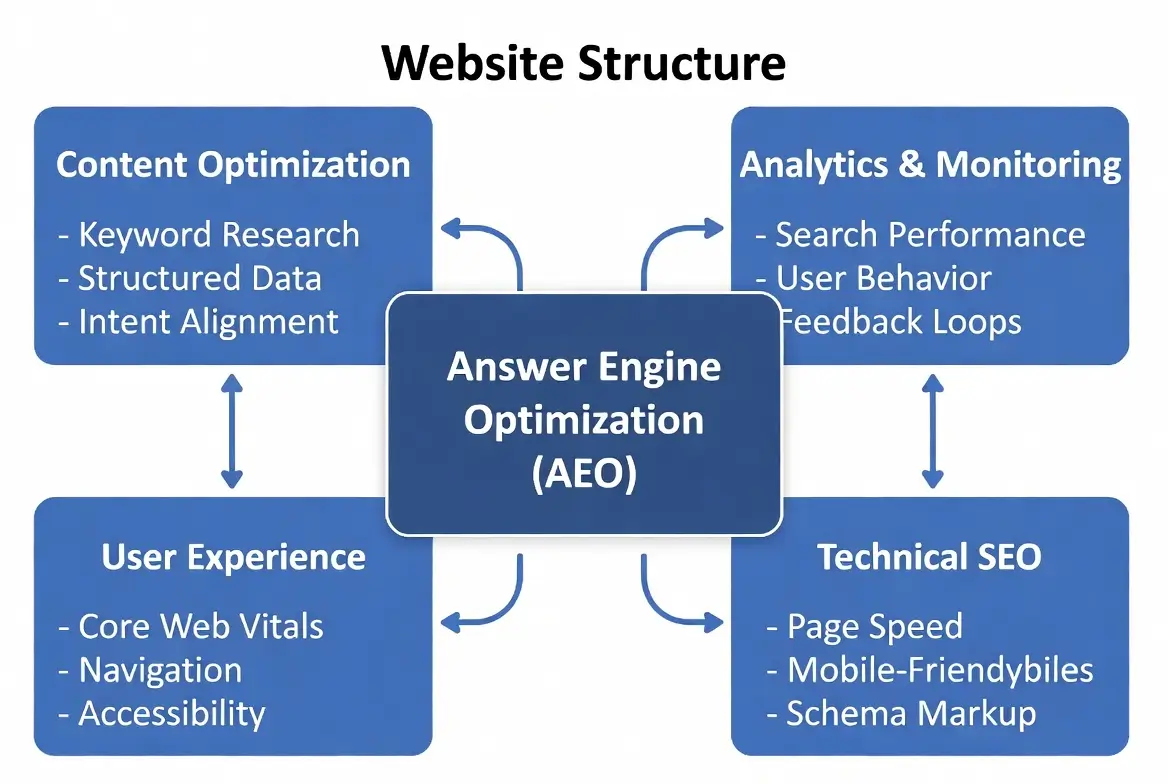
What AEO strategy should you adopt for a Webflow site?
Webflow is particularly suited to answer engine optimization because it offers complete control of HTML and JSON-LD. Here is the Synqro strategy to maximize your AEO visibility on Webflow.
First step: create a content taxonomy
Identify the top 30-50 questions your audience is asking. For each question, create a target page where H1 answers directly. This taxonomy becomes your AEO blueprint.
Second step: integrating JSON-LD into Webflow
Webflow allows you to add custom code in the global head section or per page. Synqro recommends a reusable JSON-LD template for Article, adapted per page.
Step Three: Optimizing Webflow Collections for AEO
If you use collections (blog, guides), activate the meta_description, schema_type, primary_image, and keyword fields. Each post automatically generates meta tags and a minimalist schema.
Step Four: Create Structured FAQ Pages
For each important page, add an FAQ section with the FAQ page schema. Synqro codes a reusable component: a list of questions and answers in an accordion with JSON-LD generated automatically.
Fifth Step: Internal Audit and AEO Follow-up
Use Google Search Console to see where your pages appear in Featured Snippets. Use Semrush or Ahrefs to track mentions by ChatGPT and Perplexity.
Webflow workflow for AEO:
- Create an “AEO Metadata” collection with Schema fields
- Design a template page with a reusable FAQ component
- Configure 301 redirects for domain consistency
- Implement an XML sitemap with priority per page
- Monthly Audit via Search Console (featured snippets)
How does Synqro integrate AEO into its Webflow SEO projects?
Synqro, Webflow agency certified and specialized in SEO, has been treating AEO as a strategic dimension of each project since 2024.
Initial AEO audit
We were auditing your site to identify 50+ pages that were likely to be cited by answer engines. For each, we assess:
- Presence/quality of the JSON-LD Schema
- Clarity of the main answer (first 100 words)
- Numbers of lists/tables vs paragraphs
- AEO competitiveness score (comparison with the top 3 competitors)
Writing and Structuring
Our SEO writers work in pair-programming with our Webflow developers. This collaboration ensures that 100% of your AEO-Optimized pages also benefit from robust technical markup.
Reusable AEO template
Synqro creates an “AEO-ready” page template for each client: a pre-optimized structure with reusable components (FAQ, comparison table, definition box, call to action).
Continuous monitoring and optimization
After 6 months of complete AEO optimization, our customers generally see:
- +25-35% of appearances in Featured Snippets
- +15-20% quotes per ChatGPT/Perplexity
- +10-18% organic traffic (zero-click + click to site)
Advantages of Synqro support:
- Native Webflow expertise (official certification)
- Full AEO Audit from the Start
- Synchronized Writing and Markup
- Reusable template for rapid growth
- Monthly Follow-up with Concrete Data
- Portfolio of Achievements In SEO and AEO
Synqro treats AEO not as a trend, but as the inevitable change in SEO. Your content should appeal to the Google algorithm AND generative AIs.
Frequently asked questions about AEO
Does AEO replace traditional SEO?
No AEO is added to traditional SEO, it does not replace it. Google remains the main traffic driver for 90% of sites in 2026. However, ignoring AEO means losing 15-30% of potential traffic via ChatGPT, Perplexity, and Google AI Overviews. Synqro recommends an allocation of 70% classic SEO, 30% AEO.
What is the ROI of AEO for an e-commerce or B2B site?
The ROI depends on your sector. For an informative blog or a consulting firm, AEO generates a rapid ROI (3-4 months). For e-commerce, the ROI is indirect but real: a brand mentioned by ChatGPT is perceived as 40% more legitimate.
How long until I see AEO results?
Initial results appear in 6-8 weeks (featured snippets, first quotes). Full AEO maturation takes 4-6 months. Synqro accelerates this process through its pre-optimized templates.
How do I measure my AEO visibility?
Measure three KPIs: (1) your Featured Snippet Rate in Google Search Console, (2) your appearances in Perplexity, (3) your Core Web Vitals (PageSpeed Score > 85). Synqro provides a monthly dashboard consolidating these three dimensions.
What is the first AEO action for an existing Webflow site?
JSON-LD Schema audit. 70% of Webflow sites lack structured markup. Implement Schema.org for your 20 main pages: Article, Organization, FAQ page. It is the foundation of all AI visibility.
Internal resources and links
To deepen your mastery of SEO and AEO:
- SEO: definition, trends and 2026 strategy
Schema.org structured data on Webflow: a complete guide- SEO and ChatGPT: coexisting with generative AIs
- Webflow SEO Agency: Synqro Services and Processes
Strategic conclusion
Answer engine optimization is transforming the way your content gets traffic. With 58% of Google searches resulting in zero clicks and the market for AI response engines growing by 45% per year, ignoring AEO means giving up a growing portion of your audience.
Synqro systematically integrates AEO into each Webflow SEO project, because we know that future competition is based on this dimension.
Start with an AEO audit of your 20 main pages, implement Schema.org, and review your editorial structure. In 4-6 months you will see the results.
Synqro is ready to support you. Contact us for a free AEO audit of your site.
Synqro's latest achievement