{{text}}
Share
Webmarketing brings together complementary approaches to gain visibility, attract a qualified audience and convert. If you are looking to clearly understand the differences between Seo, Sea, Sem, Smo and Sma, you are in the right place: this article sets out precise definitions, compares the levers, then proposes concrete choices according to your goals.
At Synqro, Webflow agency, we work every week on very operational trade-offs between organic acquisition, paid campaigns and social performance. Here's why you should believe us on this specific subject: when your problem is generating leads without diluting your budget, we structure a content + conversion strategy that links marketing, UX and measurement, instead of adding up isolated actions.
From the start, remember that the request “Sea salt without” reveals an intention: to know which lever to activate, in what order, and with what investment logic.
SEO: definition of natural referencing and role in visibility
La Definition of SEO refers to all practices aimed at positioning pages in a search engine without direct payment. We also talk about natural referencing, because progress depends on editorial quality, technical structure and content relevance. The SEO involves a sustainable methodology: each page must respond to a specific intention, with a keyword central and a coherent semantic field.
The SEO asks rigor, because the criteria are evolving, and SEO must rely on a measurement framework (traffic, conversions, landing pages). On a website, the objective is not only traffic: it is to guide theInternet user towards useful action, while improving the experience.
Key points to remember:
- Hn structure clear and hierarchical
- optimization content and internal networking
- work on intention and keywords
- technical performance and consistency of strategy
.webp)
SEA: understanding paid referencing and its use cases
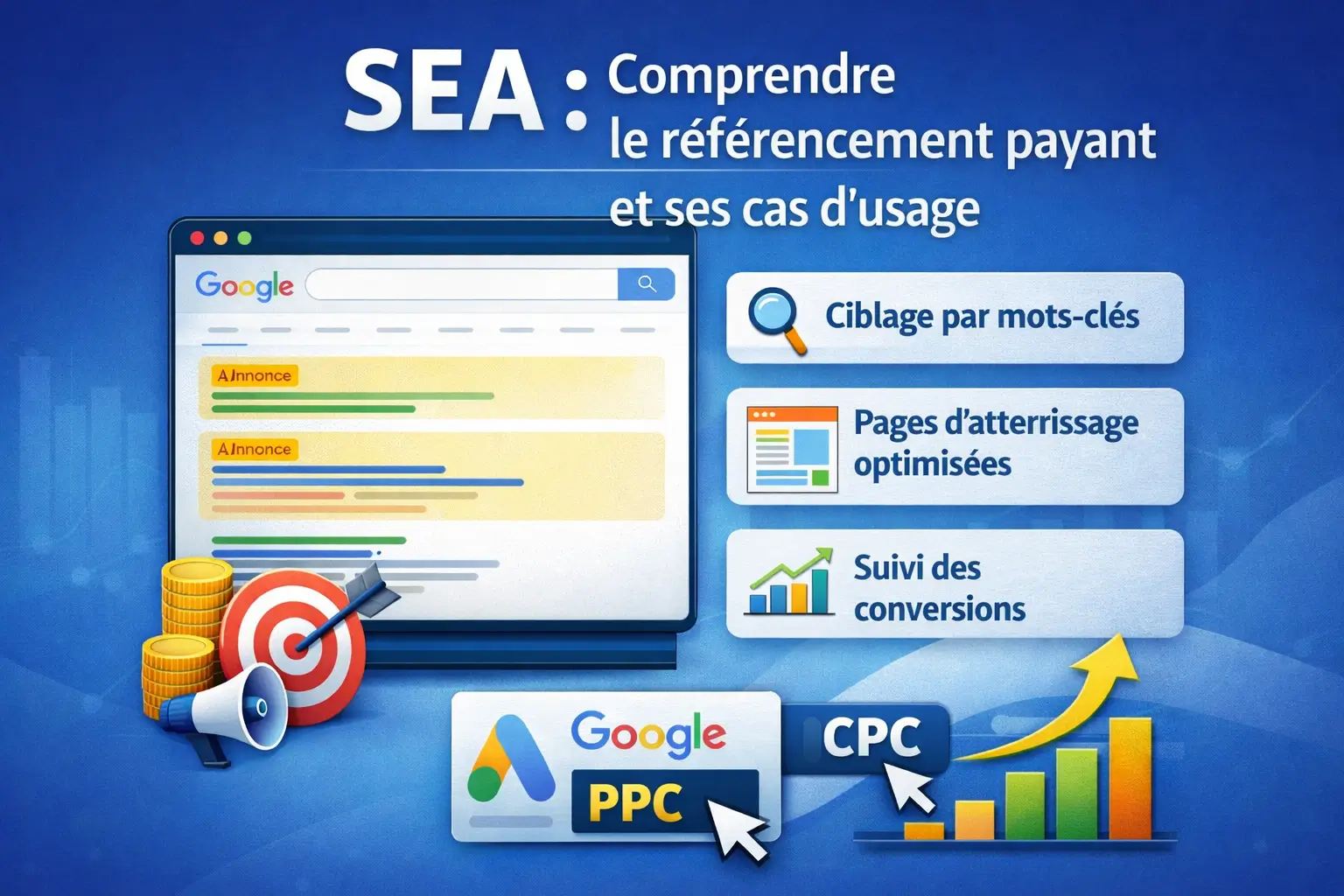
The Sea Corresponds to paid referencing : you buy advertising space on the results pages of a search engine. The lever is fast and controllable, but depends on auction logic and the quality of landing pages. In practice, the Sea offers immediate visibility, useful for testing a market, supporting a launch or capturing existing demand.
In the ecosystem Google, campaigns are managed via Google Ads (formerly Google Adwords). The principle: create ad groups, select queries, write designs and link to a dedicated page. Performance is based on relevance, the post-click experience, and the quality of measurement.
What you need to frame from the start:
- Define what you want target (intention, zone, device)
- structure the engine advertising by themes and landing pages
- control budget, requests, and ad/page consistency
- monitor The ads and conversions rather than clicks alone
SEM: what does search engine marketing cover and where is the border
The Sem Is a “hat” term that can encompass several practices related to visibility on engines. In many contexts, SEM or search engine marketing refers to the combination of organic and paid actions around results: Seo and the sea are then designed together, with a logic of global optimization of traffic and conversion. In other words, the Sem may Encompasses SEO and advertising, according to the definition adopted.
This approach is useful when you want a business reading: which channel mix maximizes leads at a controlled cost, taking into account time, competition, and the maturity of the website in buying journey. The common mistake is to treat channels in silos: we lose the coherence of messages and learning.
To clarify roles:
- Seo : builds a long-term asset
- Sea : accelerates and tests quickly
- Sem : arbitrate the mix, the measurement, the attribution
- joint management of pages, tracking and conversions
Search engines: how the results pages work
Understand The search engines allows you to better choose your priorities. One search engine analyzes, indexes, and classifies content to respond to a query. The ranking varies according to relevance, authority, and experience. On Search such as Google, the display is via The results pages, where organic content and paid placements coexist.
The ranking signals are not fixed: they exist Engine algorithms and, in the case of Google, Google algorithms evolve regularly. The objective remains stable: to provide a useful, reliable and fast response. Your job is to build pages that meet the intent, and to organize your offer so that the content is understandable.
What influences visibility:
- response quality and semantic depth
- content architecture and internal links
- speed, accessibility, and clarity of the pages
- consistency between requests, page, and conversion
Search engine optimization: pillars, best practices and mistakes to avoid
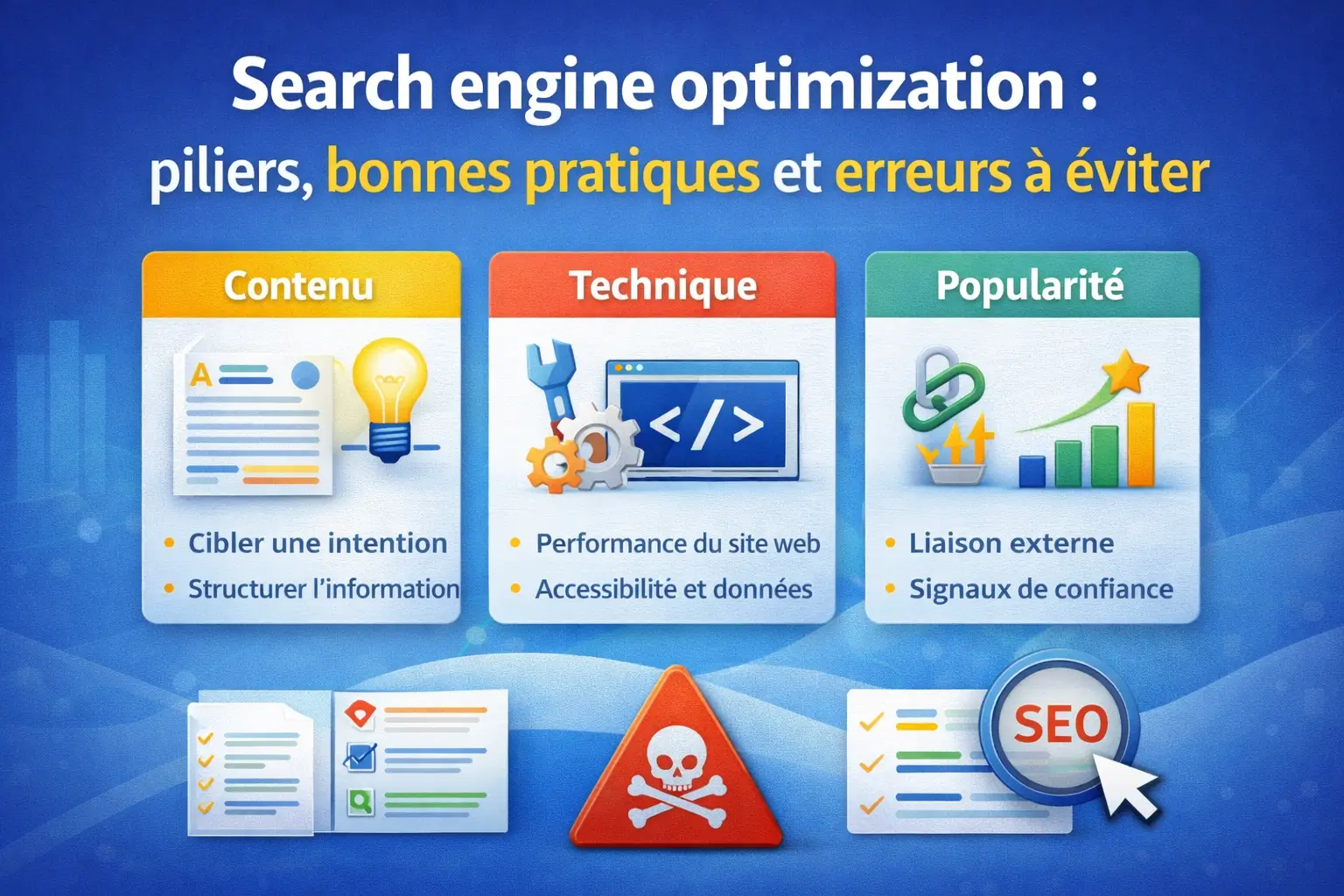
The Search Engine Optimization is based on three pillars: content, technique and popularity. The content responds to an intention and structures the information. The technique ensures that the site is accessible, efficient, and understandable. Popularity reflects trust via brand connections and signals. In this logic, all techniques should serve a purpose: to make a page more relevant, not “cheat” with the system.
Beware of risky approaches: the Black Hat SEO can cause sudden traffic losses. Conversely, a natural referencing strategy is progressing steadily, because it is aligned with user experience and editorial value.
Best practices to apply:
- choose an angle, a keyword, then a tree
- Work on the quality, the evidence, and the clarity of the sections
- consolidate the performance and readability of pages
- strengthen credibility through expert and interrelated content
Search engine advertising: structuring a profitable SEA campaign
The Search engine advertising aims to capture an existing demand at the moment it is expressed. To be profitable, a campaign must be structured: one theme = one intention = one dedicated page. The classic trap is to send everyone to a generic page: the cost goes up, the conversion goes down.
The paid referencing works best when you have a clear proposition, evidence, and a short conversion path. On such as Google, you should design the landing page as a pitch, not as a brochure. The page must also be consistent with what the ad promises, otherwise the performance deteriorates.
Items to lock:
- segmentation by intention (brand, solution, problem)
- consistency announcement → page → proof → action
- conversion tracking and query cleaning
- continuous improvement of pages and messages
SMO: social media optimization and the role of social media
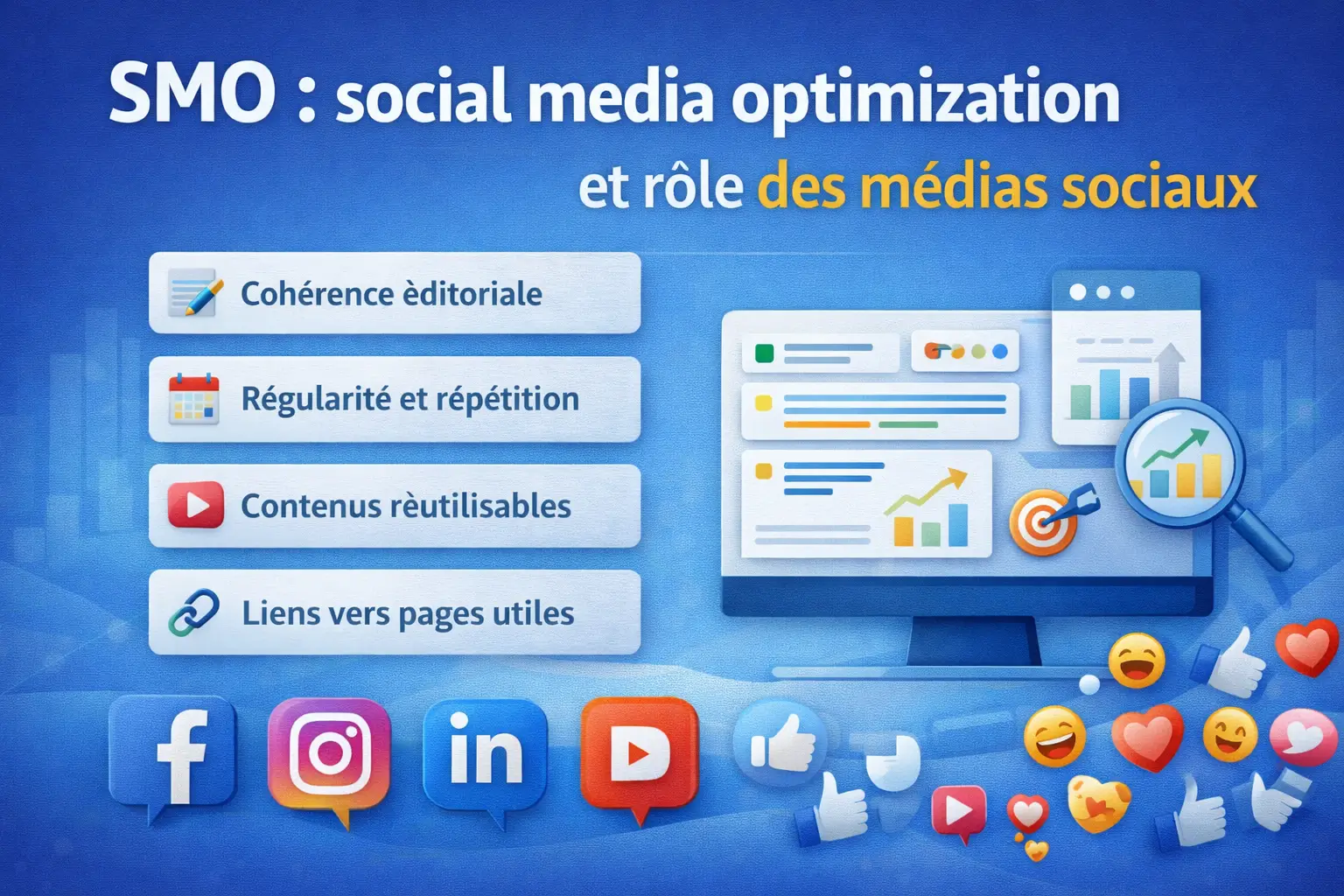
The Smo Corresponds to the Social media optimization : all actions that strengthen organic performance on networks. The aim is not only to publish, but to build a presence on social networks that supports reputation, trust and qualified traffic. This logic is based on social media : formats, consistency, editorial angles and brand consistency.
The Smo can become a discovery engine, especially for offers that can be better understood through demonstration, social proof or pedagogy. It is often linked to “top of funnel” content, but it can also fuel conversions if the journey is well thought out.
What makes the difference:
- editorial consistency and repetition of messages
- intelligent exploitation of social media
- creation of reusable content (guides, mini-cases, demos)
- links to useful pages rather than to a home page
SMA: advertising on social media and complementarity with SEA
The Sma refers to paid advertising on networks: audience targeting, retargeting, content amplification. Contrary to Sea that captures an existing intention, the Sma often creates demand: you show a message to an audience that may be interested. It is a lever powerful when you need to accelerate awareness, fill out a webinar, or feed a pipeline.
The strength of Sma is the granularity of targeting and the ability to test angles. For example, on linkedin, you can target functions, sectors, and business sizes. This is useful for B2B, but requires a clear promise and a solid landing page.
To use it well:
- Define an offer and a message per segment
- structure the funnel: discovery, proof, conversion
- align creations, landing pages and measurement
- exploit retargeting without saturating the audience
Advantages, limitations and recommendations according to your objective
In a marketing strategy, you choose channels according to time, budget and maturity. The Seo is great for durability, but slower. The Sea is fast, but depends on the budget. The Smo builds the brand, but requires editorial discipline. The Sma accelerates, but requires solid creation and measurement. In practice, Sea and the SMO work very well together: intention + discovery.
The most important thing is to think “system”: acquisition, proof, conversion. That's where the Sem takes on its meaning: orchestration, measurement, and arbitration.
Operational recommendations:
- immediate need for leads: Sea + dedicated page + tracking
- need for sustainability: Seo + pillar content + networking
- need for notoriety: Smo + amplification via Sma
- high maturity: mix Sem with continuous iterations
Synqro: how we align SEO, SEA, SMO, and SMA on Webflow
At Synqro, our approach is to link acquisition and conversion on Webflow, so that your digital strategy is not a series of isolated actions. For improve the visibility of a Brand, we start from intentions, offers and pages that convert. Then, we choose the channels and then we build an adapted content and page architecture.
Our method is based on audits, the production of efficient Webflow pages, and consistent measurement. We work on both the editorial and the structure, because a beautiful website On the engines is useless if it does not transform the request into qualified contacts.
What we are putting in place:
- SEO audit and prioritization of pages with potential
- construction of conversion-oriented Webflow landing pages
- measurement framework and iterations (messages, pages, acquisition)
- content governance to establish stable visibility
FAQ: frequently asked questions about SEO, SEA, SEM, SMO, and SMA
What is the difference between SEO, SEA and SEM for a business?
The Seo Aim for organic ranking, Sea aims for clicks through the purchase of locations, and the Sem coordinates the whole thing as a system. In a business logic, the Sem is used to arbitrate: when to invest for an immediate result, when to build a long-term asset, and how to relate all of this to the conversion. For A business, the difference is often determined by time: the Sea Accelerate, the Seo consolidates, and the Sem structures priorities and measurement.
How long does it take to see SEO results?
The time frame depends on the competition, the quality of the content, the technique and the credibility of the domain. On a A site, the first signals may appear in a few weeks, but solid progress often takes several months. The key is to align content, structure, and intent and then iterate. Visibility comes when your pages meet the needs better than others, and when the coherence of the site is strengthened over time.
Is SEA profitable when you start with a new site?
Yes, as long as you frame the promise, the page, and the measure. The Sea can be profitable from the start if you target high-intent queries, with a very clear landing page and a credible offer. Without that, the budget goes away. The idea is to test quickly: messages, audiences, pages, and then to invest more only where the conversion is demonstrated. You should also avoid sending to a A website too general: the page must have a single intention.
SMO and SMA: which one should you choose to develop an audience?
The Smo serves to build organic, regular and editorial consistency. The Sma is used to accelerate, amplify, and finely target. The choice depends on your urgency and your creative resources. If your priority is to find an audience on networks and to establish credibility, the Smo is structuring. If you need to go fast, the Sma brings reach, but you need solid content and a solid conversion path, otherwise the impact remains superficial.
Can we combine SEO and social networks without dispersing?
Yes, if you start from a core of core content and you decline intelligently. An effective approach consists in producing strong pages on the site, then in dividing them into social formats: extracts, demonstrations, cases, definitions. This reinforces consistency, prevents dispersion, and improves overall performance. The key point is to maintain a stable editorial line and to link each piece of content to an intent and a useful page.
What mistakes prevent improving online visibility?
Recurring mistakes are the confusion of objectives, the multiplication of weak pages, and the lack of measurement. We also see sites that publish without a strategy, or that launch campaigns without adapted pages. For improve visibility, you need logic: a clear offer, a structure, content that meets intentions, then a measurement loop. If you do “a little bit of everything,” you don't learn anything. An effective strategy is based on includes all techniques useful, but organized around priorities, not piled up.
What to remember to build a coherent web marketing strategy
- Seo : a long-term asset to capture sustainable demand on a search engine
- Sea : an accelerator to test, launch and secure leads
- Sem : an orchestration logic that links acquisition, pages and conversion
- Smo : an editorial discipline to strengthen the brand on networks
- Sma : a lever for amplification and targeting, particularly effective in B2B
- The right mix depends on your objective, your budget, and your conversion maturity
Synqro's latest achievement