{{text}}
Share
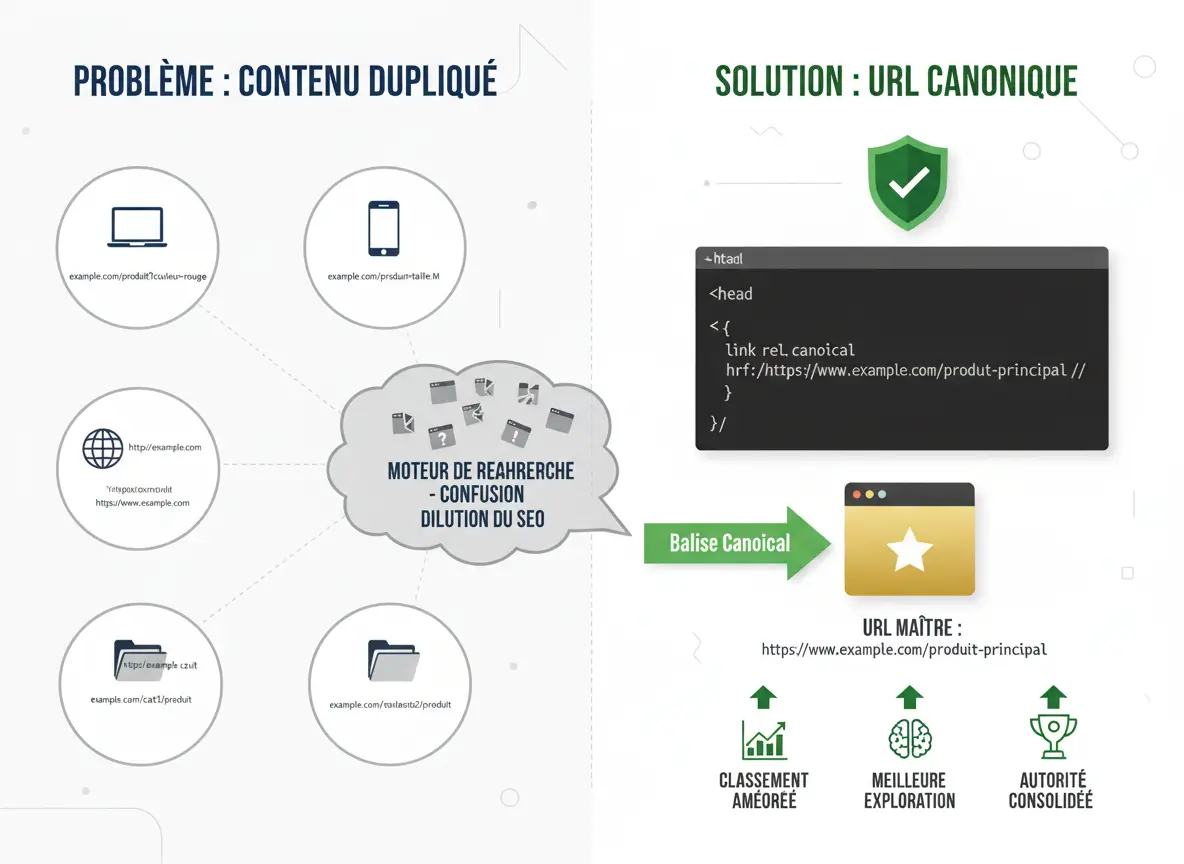
La canonical tag used to indicate unto google What address should be considered as the reference version when there are several very similar variants. This setting is a simple but decisive lever to clarify which version to use in search results and avoid a dilution of relevance.
Chez Synqro, Webflow agency performance-oriented, we work on sites where variants are born from filters, marketing parameters, versions http/https or navigation structures that are too permissive. Our approach is based on concrete settings: architecture, redirections, coherence of internal links, and specific implementation in the html code. It is precisely this “invisible” work that secures the natural referencing.
Canonical: definition and role of the reference URL
Canonical is an indication given to a search engine To designate the version canonical of a document. When there are several paths to the same resource, this signal makes it possible to centralize authority and to avoid that a variant is interpreted as an autonomous entity. In practice, it is a way of arbitrating between multiple pages close ones, without necessarily deleting them.
It is not a blockage. Exploration tools can always discover different versions, but the aim is to specify which should be preferred in the index. This point is particularly useful when a variant is still necessary for the user, but does not provide additional SEO value.
Key points to remember:
- It refers to the version canonical to be preferred in the results.
- It limits the effects of internal competition between variants similarS.
- It consolidates popularity signals on a single address.
- It clarifies variations resulting from filters, parameters, or navigation.
Why do address variants appear and create duplicates
On the web, duplicate addresses appear quickly. A sorting, a filter, a campaign parameter, or a list system can create dozens of combinations of the same resource. For a search engine, these combinations sometimes look like separate documents, which can fragment understanding and dilute visibility.
The main risk is not necessarily “being sanctioned”, but a loss of efficiency: exploration is dispersed, and relevance is spread over several competing variants. On Of the sites This large noise slows down the discovery of truly strategic documents and complicates the consolidation of signals.
Common sources of duplicates:
- Sorting and filtering on a catalog, especially in e-commerce.
- www/non-www versions or http/https not standardized.
- Access to the same element via categories, tags, internal search.
- Tracking settings (utm, gclid) that multiply addresses.
Canonical tag: where it is placed and how it is interpreted
Technically, canonical is a link declared in the header of the document, usually in the Head. In the Source code, it is found in the form of a html tag Link type with an attribute Rel. Its role is to suggest a preferred address, but the search engine keep a margin of interpretation: if the signals contradict each other, he can ignore the recommendation.
For it to be followed, the destination must be coherent: identical subject, stable access, and absence of contradictions with the internal network. If you point to a destination that doesn't have the same theme, or that redirects to something else, you're producing a weak signal. In some cases, this inconsistency may penalize visibility by creating uncertainty.
Best implementation practices:
- Point to a stable and accessible destination in 200.
- Use a clean address, without unnecessary parameters.
- Avoid channels where the destination redirects multiple times.
- Align this signal with internal networking and sitemaps.
.webp)
rel tag: how does the link attribute work and when to use it
The attribute Rel is used to specify the relationship between a document and a reference resource via a Link. In an SEO approach, this logic makes it possible to consolidate a priority signal when the same information is accessible by several technical paths. The interest is to limit internal competition between very similar variants, and to make the interpretation more stable for a search engine.
On a site, these variants often appear because of marketing parameters, duplicate templates, or multilingual architectures. The classic mistake is to apply a single rule everywhere, without checking the real consistency of the target document. Good use is to link a variant to its version canonical only when the difference does not bring SEO value distinct.
This lever is particularly useful for sites where navigation produces large-scale variants.
Points of vigilance to apply:
- Verify that the reference resource returns a stable status.
- Avoid redirection chains between the variant and the target resource.
- Ensure that the internal mesh pushes towards the main version.
- Check that the destination covers the same intention and the same subject.
E-commerce platform: manage sorting parameters without generating duplicate content
On a platform e-commerce, the majority of duplicates come from parameters: sorting by price, color filters, sizes, stocks, nested categories. These combinations are useful to the user, but they can disturb the index if they become competing, almost identical, and massively explored variants.
The objective is to establish governance: which combinations must remain accessible, which must be neutralized, and which deserve a comprehensive SEO treatment. A variation can be legitimate if it meets a strong and stable intention. If not, it should be treated as a technical variant, in order to avoid the dispersion of relevance and the appearance of duplicate pages.
Piloting is done by rules. It is also a performance driver: fewer useless variants mean more resources devoted to the sections that matter.
Recommendations to apply:
- Standardize marketing parameters and limit indexable combinations.
- Prioritize categories and avoid multiple paths to the same listing.
- Set up filter management rules according to the intention.
- Regularly check consistency via crawl audits and log file.
Referral URL vs redirection: how to choose the right lever
A redirection is used to permanently move a resource: the user is sent to a new destination. Canonical, on the other hand, is used to prioritize variants that can remain accessible, in particular for the user experience or marketing needs. It is a difference in purpose: one changes the destination, the other guides the arbitration of the index.
In practice, redirection is used when the old address is no longer intended to exist (redesign, change of structure). Canonical is used when one accepts several variants, but wants to clarify which one should be put forward.
Benchmarks for deciding:
- Redirection if the old address should disappear and be replaced.
- Canonical if the variant should remain accessible (filters, tracking).
- Mandatory coherence between the two, without contradictory signals.
- Check in Search Console to confirm the selected version.
.webp)
When to use canonical on a website
The canonical becomes useful as soon as a website generates technical or structural variations. The most common cases are the presence of parameters, the management of collections, or the unintentional duplication of similar documents. The challenge is to choose a “clean” version to capitalize on the signals and reduce noise.
It is also relevant for similar texts published for different purposes, such as campaign landing pages. In this case, you must remain careful: if the intentions are really distinct, it is better to differentiate the content rather than to merge it via a reference signal. The objective is to maintain theutility of each document, without reducing theentirety visibility opportunities.
Common use cases:
- Sort settings and filters that multiply variants.
- Access to the same document from several categories or tags.
- Marketing variants with tracking and parameters.
- Very similar declinations where only one version must dominate.
What Google expects: consistency, aligned signals, and engine choice
The engine analyzes several indexes: content, internal links, sitemaps, redirects, and the declared canonical. If everything converges to the same version canonical, it generally follows the instructions. If the signals diverge, he may choose another version, sometimes different from the one suggested.
The right objective is not to “force” an engine, but to make the choice obvious. When the architecture is clear, the signals are consolidated naturally, and The contents gain in positioning stability. It also limits unnecessary exploration costs.
This reinforces the signal:
- Internal mesh oriented to the main version.
- Sitemaps and links consistent with the reference address.
- Clean redirects, no loops or chains.
- Variants that are limited and justified for the user.
Common mistakes that trigger noise and loss of visibility
The most frequent errors come from templates: the same canonical injected everywhere, or a default destination to a generic section. Another error: sending specific documents to a category page, which prevents these documents from positioning themselves on their own intent.
We also see technical inconsistencies: declaring a “clean” address but generating internal links to variants, or letting the destination be redirected. In these scenarios, the engine receives a confusing and arbitrating message from itself. It's typically the kind of Case scenario where you lose visibility without realizing it.
Mistakes to avoid:
- Declare the same signal throughout the site via a template.
- Point to a destination that redirects or does not respond in 200.
- Link documents that serve distinct purposes.
- Allow the mesh to push competing variants.
.webp)
Synqro method: clarifying addresses and stabilizing indexing on Webflow
On Webflow, the priority is governance: ensuring that each CMS template and each static page emits the right signals. We start by identifying the sources of variation and then we establish rules by document type. Then we set up This tag in a clean and measurable way, without destructive automation.
In concrete terms, it is ofteninsert tag in the right place, to check that there is onlyA beacon relevant per document, then to check the rendering in the Source code. We complete with a crawl-oriented reading: what The crawlers actually see, and what a updating This template can change without warning.
What we are putting in place:
- Audit of the causes of duplicates and the impacted models.
- Version rules canonical by intention.
- Correction of the internal mesh and associated redirects.
- Post-deployment check to validate behavior efficiently.
Conclusion: reduce duplicates, consolidate signals, gain stability
La canonical tag is used to make an architecture legible when several variants coexist. Used methodically, it limits internal competition, consolidates popularity signals and stabilizes visibility. Used randomly, it removes useful documents from the results or creates contradictions.
Priority actions:
- Identify address variants that do not provide value.
- Choose a main version that is clear, clean, and stable.
- Align internal links, sitemaps, and redirects with this choice.
- Check the selected version in Search Console.
Canonical FAQ: frequently asked questions
What is a canonical URL and what is it used for?
A canonical URL corresponds to the version canonical of a resource, the one you want to see preferred when several variants exist. It is used to consolidate SEO signals on a single version and to prevent technical copies from competing with each other. The aim is to make the choice obvious in the results.
Is Google still following the declared canonical?
No Google sees it as a signal. If the internal linking, redirections, or sitemaps contradict the indication, he can choose another version. One expert will therefore seek to align all the signals rather than relying solely on this setting.
Canonical and pagination: should all pages be canonized to the first?
In most cases, no. Consistently canonicalizing a list at first glance may prevent the discovery of some items that can be accessed later. The strategy depends on the context: either each view refers to itself, or you choose not to index it if it has no SEO value. The important thing is to stay consistent.
Can duplicate content be corrected only with a canonical one?
It helps, but it's not enough if the structure generates a lot of variants. When duplicates come from parameters or templates, you have to act at the source: limit variations, clean up the internal mesh and structure the architecture correctly.
How do I check the version selected by Google?
The most reliable method is Search Console. For a given address, you can see which version was declared and which version was selected by Google. If they diverge, you must Understand how the signals are interpreted and the inconsistencies are corrected.
How to implement a canonical on Webflow?
On Webflow, you can manage this signal via the SEO settings of static pages and CMS templates. The verification is done by checking the Source code and the location in the head, then validating the behavior in Search Console.
Can a misconfigured canonical cause traffic to be lost?
Yes. If you link to a destination that is too generic or irrelevant, you can remove a useful document from the results and lose search intent. This is why this adjustment must be treated as a precision mechanism.
When should a redirection be preferred to a canonical one?
Redirection is preferred when the old address must be replaced permanently. We prefer the canonical one when a variant must remain accessible, but you want to focus visibility on a main version.
Do UTM parameters need to be canonicalized?
Yes, generally. Tracking parameters should not create a new indexable entry. Good practice is to keep the address clean as a version canonical, and to avoid internal networking pointing to variants.
Can we have several canonicals on the same page?
No It is necessary only one canonical url per page. Multiple statements create an ambiguous signal that is often ignored. Ideally, the value should be an address Absolute rather only a relative one, in order to avoid errors related to domains, sub-domains and The addresses alternatives.
What is the best page when two variants exist?
The answer depends on intent and overall consistency. In general, we prefer the most stable version, the most internally linked, and the most complete. The question”What is the page to keep” must be decided with a clear rule and then applied repeatably.
How do you solve duplicate content problems without affecting the design?
The resolution starts with the structure and the technical rules. You need to identify competing variants, then align redirections, internal networking, and header signals. The design can remain the same, as long as the architecture limits duplications and avoid problems recurring.
What mistakes can cause a search engine to ignore the referral signal?
The most common mistakes are contradictions between signals, destinations that redirect, templates that inject the same rule everywhere, and variants that are too different in substance. When that happens, you need to simplify the architecture, strengthen the mesh, and verify that the similar pages do not contradict each other.
The objective is to designate a version canonical when variants exist.
The coherence of the signals is more important than the repetition of the word “canonical.”
A clean implementation on Webflow requires well-governed templates.
Validation is done via Search Console and technical tests.
Synqro's latest achievement