
{{text}}
Share
SEO KPI: 7 SEO indicators to follow
Piloting the natural referencing without measure is the same as making blind decisions. Les SEO KPI serve to objectify progress, to prioritize actions, and to prove what really contributes to the growth of a website. This guide gives you a clear method for evaluate your results, build a management table, and monitor 7 indicators really useful.
Chez Synqro, Webflow agency performance-oriented, we support marketing teams who want a website more visible, faster and more profitable. Our approach is pragmatic: structure the data, set goals, then iterate on the pages that generate the most impact. This is precisely what distinguishes “reading stats” from effectively monitoring KPIs.
In the domain of natural referencing, numbers are only useful if they guide a decision. Les indicators to follow must therefore be limited, stable and linked to your objective: visibility, qualified demand and conversion. These Indicators allow also to quickly detect a technical dropout or a drop in attractiveness in the results. In other words, SEO is significant only if you know follow your indicators and turn measurement into implementation priorities.
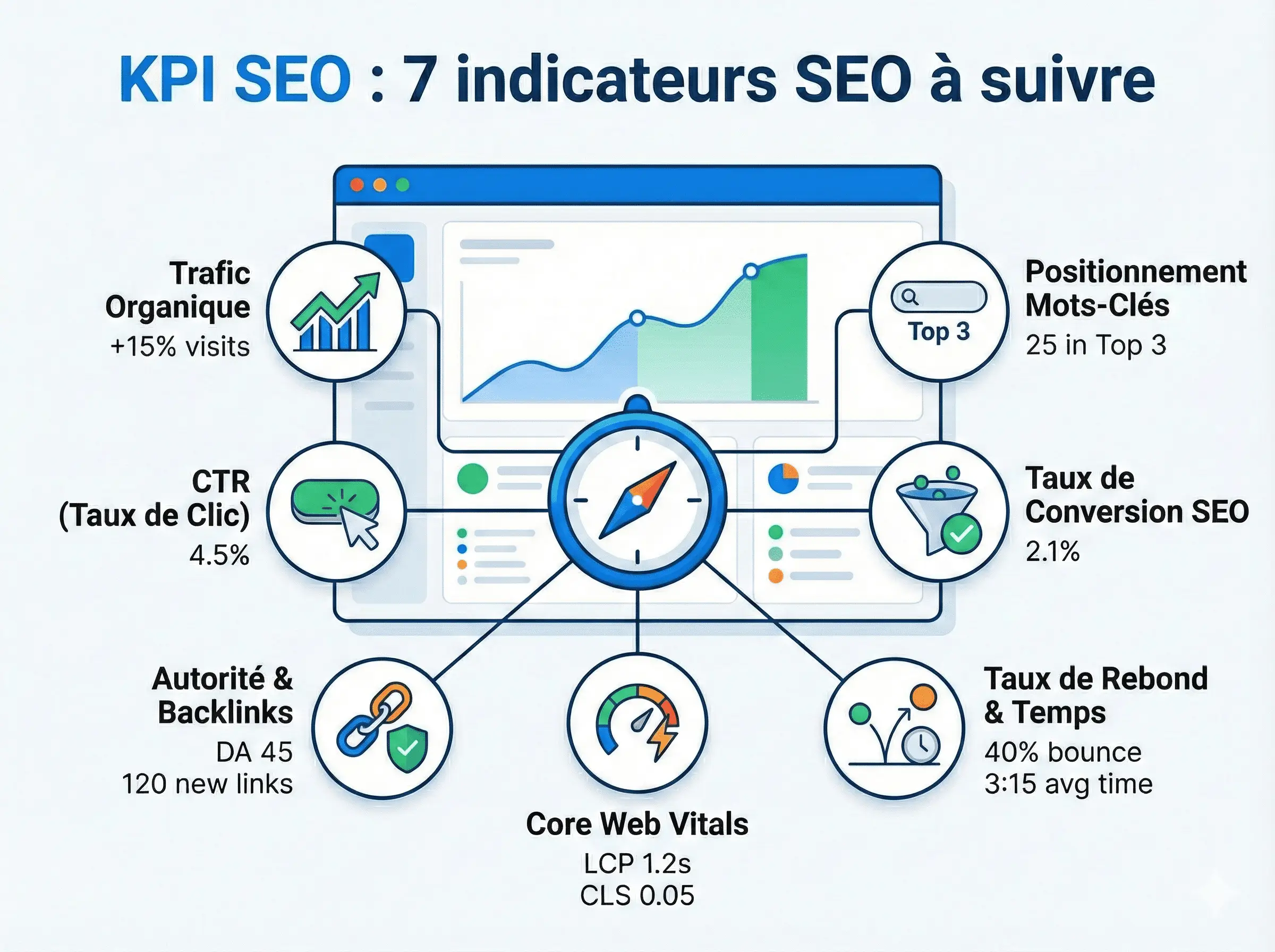
What is a KPI and why do SEO KPIs really matter?
What is a KPI : a measurable indicator that translates an objective into numbers, in order to manage progress. In the field of SEO, a KPI is not only a volume of visits. It is a key performance indicator that connects visibility, commitment and business. We also talk about Key Performance Indicator when you formalize this role in a marketing management more global.
The trap is multiplying metrics. Several KPIs may be available, but not all are actionable. A good KPI should help you decide: what to fix, what to strengthen, what to stop. The value of a KPI is judged by its relationship with your goals: leads, qualified demand, sales, reputation.
In this context, the Kpis SEO should be understood as Key performance indicators of the organic channel. One Kpi and SEO Is often One of the KPIs most useful when it relates visibility to a possible action on the website. In other words, a KPI is not a statistic: it is One of the indicators Which is used to assess performance and to arbitrate between technique, content and conversion.
To define a useful SEO KPI:
- A metric should be measurable, stable and comparable over time
- One performance indicator must be linked to a possible action
- A KPI should highlight the priority between content, technique and conversion
- A KPI reading must distinguish visibility, commitment and business results
Which KPIs should you choose to monitor your natural referencing without making mistakes?
The question What kpi Follow depends on the type of website, the maturity of your content, and the role of SEO in your acquisition. A showcase site does not have the same challenges as a Editorial site or a multi-page B2B platform. However, the best KPIs remain the same: those that reflect the real journey between the page displayed and the objective reached.
Consistency is essential: a KPI should follow an intention, not an obsession with volume. For example, the increase in impressions may be positive, but if the conversion does not evolve, there is a lack of a link between traffic and value. You must therefore articulate your KPIs around a SEO strategy clear and with an identical analytical framework every month.
To avoid bad choices:
- A KPI should reflect a goal of website (visibility, demand, sales)
- A KPI must be segmentable by page, query, content type
- A KPI should be read with the context of search results
- A KPI must be able to trigger an improvement (content, technique, UX)

SEO dashboard: how to assess the indicators at the right level?
One seo dashboard is not decorative reporting. It must answer a single question: “What SEO actions should I prioritize now?”. The aim is to centralize data useful, to limit noise, and to make visible the evolution of the performance of your site. A good dashboard helps you analyze the trends rather than commenting on daily variations.
The measurement base is generally based on Google analytics and Google Search Console. One describes the behavior on the website, the other describes the exhibition in the search engine. The combination is essential, because an increase in clicks can mask a decrease in quality, and an increase in sessions can mask a decrease in value.
To structure a useful dashboard:
- One scorecard must separate visibility (SERP) and on-site performance
- A table should isolate the strategic pages and their monthly trends
- A table should follow the link between pages and conversion
- A table should make readable SEO data by segments (brand, content, services)
Indicator 1: organic traffic, useful volume and quality of acquisition
The organic traffic is the first signal of SEO growth, but it must be interpreted correctly. One website can increase its traffic while degrading its quality if the new pages attract an unqualified audience. The objective is not “more visits”, but “more useful visits”. This is where the analysis by page and by intention becomes decisive.
For evaluate This KPI, segment by content type, business pages, informational pages, and brand queries. A healthy increase in organic traffic must be accompanied by a better depth of reading, a better conversion rate, or an increase in requests. The KPIs can never be read alone, they are confirmed by each other.
What to watch to make traffic actionable:
- An evolution of traffic by type of page and by intention
- A portion of traffic on the “money pages” pages of website
- An increase in traffic on requests consistent with your offer
- An ability to measure performance per page rather than globally

Indicator 2: impressions and visibility of your website in search results
Visibility doesn't start with a click. It starts to be displayed in search results. Impressions allow you to read the real exposure of your site on a search engine before users even click. This is a useful signal to understand if your content is “getting on Google's radar”, especially on new pages.
For serious piloting, use Google Search Console to link impressions, pages, and queries. An increase in impressions without an increase in clicks often reveals a problem with positioning, relevance of the snippet, or poorly addressed intent. A combined increase indicates improved semantic coverage and content performance.
Effective reading points:
- An increase in impressions on the strategic pages of website
- A breakdown of impressions by request and by intent
- A reading of the impression vs click gap to adjust titles and content
- An analysis of the pages that emerge in The results pages without performing yet

Indicator 3: clicks and click rates, the true meaning of attractiveness
The Click Translates a choice. It indicates that your result was deemed more relevant than others. For a controlled SEO, the click must be read in conjunction with the position and the context. The objective is not to collect as many “easy” clicks as possible, but to capture those that correspond to a useful intention and a controlled promise.
Here, the nuance is crucial: The clicks are not an isolated KPI, they are part of a chain. If users click on a link Then leave again, you won a click but lost an opportunity. The quality of the click depends on the consistency between snippet, content and value proposition. It is an indicator that can be directly actioned by optimizing titles, meta descriptions and content angle.
To exploit this KPI:
- A reading of the number of clicks per page and per request
- An analysis of the gap between position and click to improve snippets
- A consistency check: promise → content → conversion
- A prioritization of pages with high click potential in a search engine

Indicator 4: bounce rate, correct interpretation and useful thresholds
The bounce rate is often misunderstood. However, it remains a useful signal to diagnose an inconsistency between the intent and the page. Yes, the bounce rate can be normal on a page that answers a question perfectly. But one bounce rate High on a page that's supposed to convert frequently indicates a problem with experience, speed, or promise.
So you have to read it at the right level. A rebound is not always negative, but Rebound is a kpi when it reveals a discrepancy between the purpose of the page and the actual behavior. Use Google analytics to segment by page, device, and source. The rebound becomes actionable as soon as it is related to the time spent, the depth of navigation and the conversion.
To analyze the bounce rate:
- A desktop vs mobile bounce comparison on the website
- A bounce reading by intention (information vs transaction)
- A detection of pages where the bounce blocks the conversion
- An identification of pages requiring UX or performance improvement

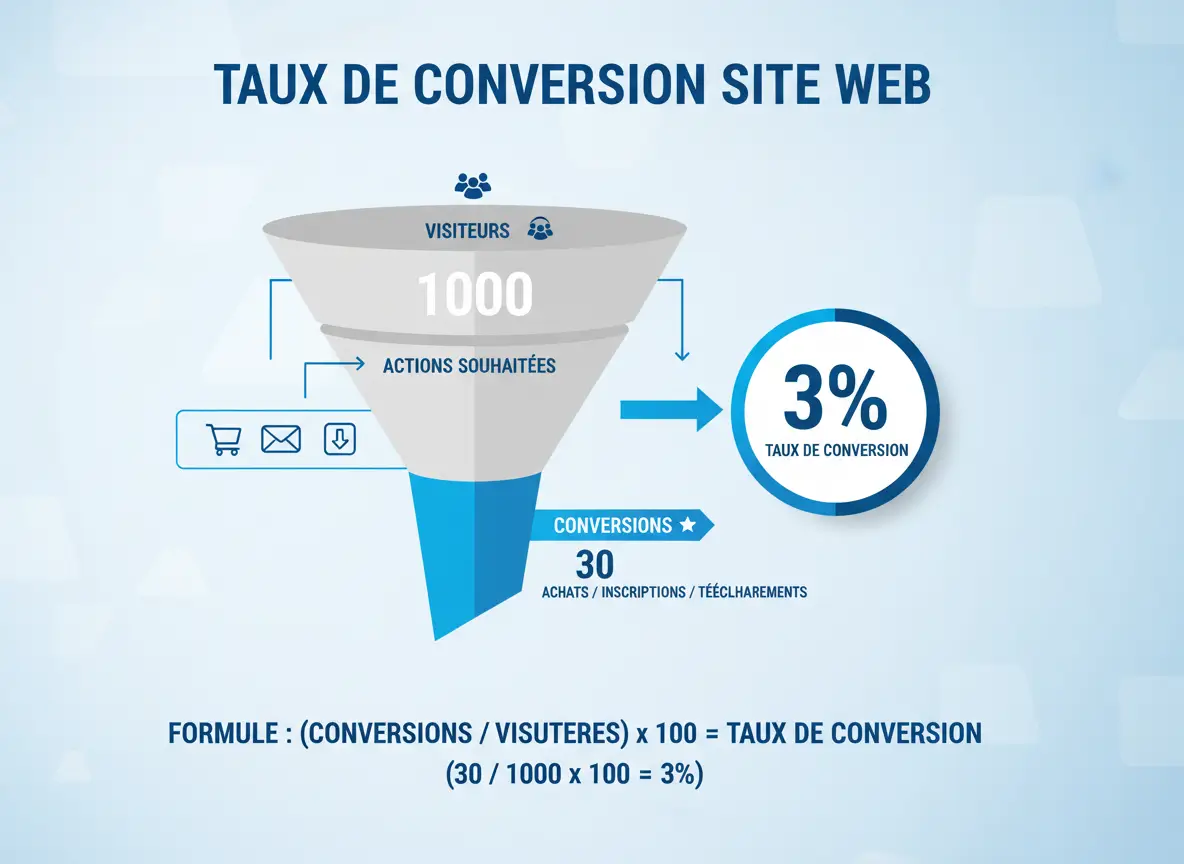
Indicator 5: Conversion rate, the KPI that really cuts out performance
SEO only has business value if it contributes to conversion. This is where KPIs stop being visibility metrics to become real performance indicators. The conversion can be a lead, a quote request, a download, a registration. The conversion rate allows you to compare pages with each other, regardless of the volume of traffic.
A site can have modest traffic and an excellent conversion rate, making it a profitable channel. Conversely, a highly visible site may have a low rate if the pages do not meet the intent or if the journey is not clear. This is why the conversion must be precisely defined, properly tracked, and linked to SEO pages.
To manage SEO conversion:
- A clear definition of conversions and micro-conversions on the website
- A follow-up of conversion rate per page and per intent
- An analysis of the user path between SEO page and form
- A reading of the effectiveness of your SEO strategy through conversions, not only through traffic
Indicator 6: indexing, page health, and technical stability
One website can lose SEO performance without the content changing, simply because of an indexing or crawling problem. The engines rely on The search engines and their robots to discover, understand and maintain pages in the index. If your site is poorly explored, you lose visibility, regardless of your content.
In Google Search Console, monitor indexing reports, errors, exclusions, and coverage. This KPI is often underestimated, even though it determines all the others. In a rigorous approach, indexing is one of Essential SEO KPIs : it indicates whether your pages can actually appear in the results.
What you need to check:
- An evolution in the number of pages indexed and exclusions
- Fast detection of errors that block exploration
- Coherence between sitemap, mesh and really useful pages
- Technical stability that protects the performance of your strategy

Indicator 7: SEO performance, engagement and trust signals
La SEO performance is not limited to positions. It also depends on signals of trust: relationships, brand consistency, perceived quality, commitment. The engines observe the robustness of a site over time. The more your site inspires confidence and accurately meets the intentions, the more your results stabilize.
On a website oriented towards acquisition, this KPI can be read through several combined indicators: pages that are progressing sustainably, content that generates conversions, and external signals that reinforce legitimacy. This is also where the management of key indicators rather than isolated metrics. KPIs are used to detect what “sticks” over time.
To measure this overall indicator:
- A reading of the pages that are making lasting progress in results
- An analysis of content that generates long-term conversion
- An observation of the stability of performances over several months
- An ability to connect visibility, commitment and trust in drivers

Synqro: how to track the right KPIs and turn measurements into actions
Follow-up is only useful if it triggers decisions. At Synqro, we help teams build a management system that connects SEO, content, UX and conversion. This involves a framework of objectives, a limited selection of indicators, and a monthly analysis routine. Our role asSEO agency is to transform numbers into concrete priorities on the website.
We generally structure management around three levels: visibility in engines, page performance, and business. That's what makes tracking KPIs useful, even for organizations that publish a lot. In this logic, we distinguish some KPIs that describe the activity (traffic, click) and those that describe the impact (conversion, strategic pages).
Our monitoring framework:
- One KPI tracking focused on business pages, not on vanity metrics
- One monitoring of key indicators structured by intent and type of content
- A monthly routine for identify the optimization priorities
- Implementation of SEO actions on the pages that create the most value
Conclusion: the best SEO KPIs to monitor your indicators without dispersing
SEO management requires discipline. You need to limit the number of KPIs, follow trends at the right pace, and link numbers to decisions. Les The most important SEO KPIs are not the ones that look “good” in reporting, but those that make it possible to improve a site: visibility, clicks, engagement, conversion, indexing. Good follow-up helps you choose the right battles, instead of optimizing everything, everywhere.
Finally, remember that SEO allows sustainable growth only if the measure is structured. The KPI is not an end: it is a governance tool. One kpi allows to decide, prioritize, and prove the real impact of SEO work on Natural referencing of your site.
To remember:
- A good KPI must be actionable and linked to the business
- A dashboard should isolate strategic pages and their trends
- Follow-up must combine visibility, engagement and conversion
- The best KPIs are the ones that guide a monthly action plan
KPI SEO FAQ
What are the 7 SEO KPIs to follow first?
The priority KPIs cover the complete chain between visibility and result: organic traffic, impressions, clicks, click rates, bounce rates, bounce rates, conversions, and indexing. The important thing is to read them together, because they validate each other. An increase in impressions without clicks does not have the same meaning as an increase in clicks without a conversion. The selection must remain stable in order to compare trends, not snapshots.
What is the difference between indicator, metric and SEO KPI?
A metric is raw data, such as the number of sessions or the average time. An indicator is a metric that is interpreted in a context, for example a monthly change or a difference by segment. A KPI is an indicator chosen because it drives an objective, and therefore an indicator that triggers a decision. The key difference is the use: a KPI structures management, while a metric describes a situation.
How often should SEO KPIs be analyzed?
The frequency depends on your volume and maturity. For the majority of sites, a monthly analysis is the most effective pace, because SEO is an inertial channel. A weekly reading can be useful for detecting technical incidents, but it should remain alert oriented. The right pace is one that allows you to compare trends, execute actions, and then measure their effect.
Google Analytics or Google Search Console: Which is more important?
The two are complementary. Search Console describes performance in search results: impressions, clicks, queries, pages. Analytics describes behavior on the site: engagement, bounce rate, conversion. Without Search Console, you don't understand visibility. Without Analytics, you don't understand the value. Serious management uses both, with a coherent reading of strategic segments and pages.
How to interpret a high bounce rate in SEO?
A high bounce rate doesn't have to be negative. On a page that answers a simple question, bouncing can mean that the answer was found quickly. On the other hand, on a service page or a page that is supposed to convert, a high bounce often indicates a problem with intent, promise, or experience. The correct interpretation is to read it with the time spent, the navigation, the conversion, and the device.
What KPIs to follow for a B2B site that targets leads?
For a B2B site, KPIs must link visibility and pipeline: organic traffic on offer pages, clicks on commercial queries, conversion into forms or appointments, and conversion rate per page. It is also useful to monitor indexing and technical stability, because a B2B site often relies on pillar pages that must remain visible. Management should be focused on business pages rather than global volume.
How to build a simple and actionable SEO dashboard?
A simple dashboard starts with a limited list of KPIs and then segmented by strategic pages. It should show monthly trends and comparisons, not isolated numbers. It must also link each KPI to a possible action, such as improving a title, consolidating content, or correcting an indexing problem. Simplicity comes from stability: same KPIs, same segments, same pages, same pace.
What KPIs should I follow if my site has just been launched?
On a recent site, the priority is to verify the ability to be explored and indexed, then to monitor the emergence of visibility. The first useful KPIs are indexing, impressions, queries that appear, and clicks. Only then come the engagement and conversion KPIs, because they require a minimum volume. The objective is to validate the technical base, then to install a regular progression.
Can you improve your SEO KPIs without publishing more content?
Yes, if you work better what already exists. Optimization can focus on titles, intentions, structure, internal networking, speed, and conversion. Often, consolidating a few important pages has more impact than publishing weak new articles. The most cost-effective approach is to identify potential pages, improve the content, strengthen the evidence, and then measure the effect on clicks and conversions.
What KPIs show the effectiveness of an SEO strategy in the long term?
Over the long term, the KPIs that matter are those that stabilize and create value: growth in qualified organic traffic, improved conversion rates, stability of strategic pages, and sustainable progression of clicks on useful queries. Longevity is also seen in the ability of a site to withstand fluctuations: if your pages remain efficient, it is a signal of quality and consistency.
- A good KPI should guide a decision and not just describe a state.
- A dashboard should connect visibility, engagement, and conversion
- The most useful KPIs can be read by page, intent, and segment
- SEO management becomes effective when measurement triggers actions
Synqro's latest achievement